
The Impact of Weight-loss Medication on Consumer Behaviour & Psychology.
GLP-1 weight-loss drugs are fundamentally reshaping how people eat, drink, and spend. We've been tracking what the data actually says, and what it means for brands navigating the shift. Our take is that the accessibility of GLP-1 medication is not only shaping the behaviour of those actively taking the medication , but fundamentally changing the wider consumer psychographic landscape.
The Numbers
The share of US households with at least one GLP-1 user rose from roughly 11% in late 2023 to more than 16% by mid-2024.[1] A Gallup survey confirms the number of Americans taking semaglutide or tirzepatide more than doubled in just eighteen months, from 5.8% in early 2024 to 12.4% by late 2025.[2] J.P. Morgan now estimates approximately 25 million Americans will be on GLP-1 treatment by 2030, up from around 10 million today.[3]
These are not marginal numbers. When nearly a quarter of US households already contain a GLP-1 user, and that cohort is projected to account for 35% of all food and beverage purchasing by 2030[4] the consumer landscape is massively changing.

The Numbers Are Unambiguous
A Cornell University study, published in the Journal of Marketing Research, linked GLP-1 survey data to purchase records from tens of thousands of US households, making it one of the most rigorous real-world analyses of GLP-1 behavioural impact conducted to date.[1]
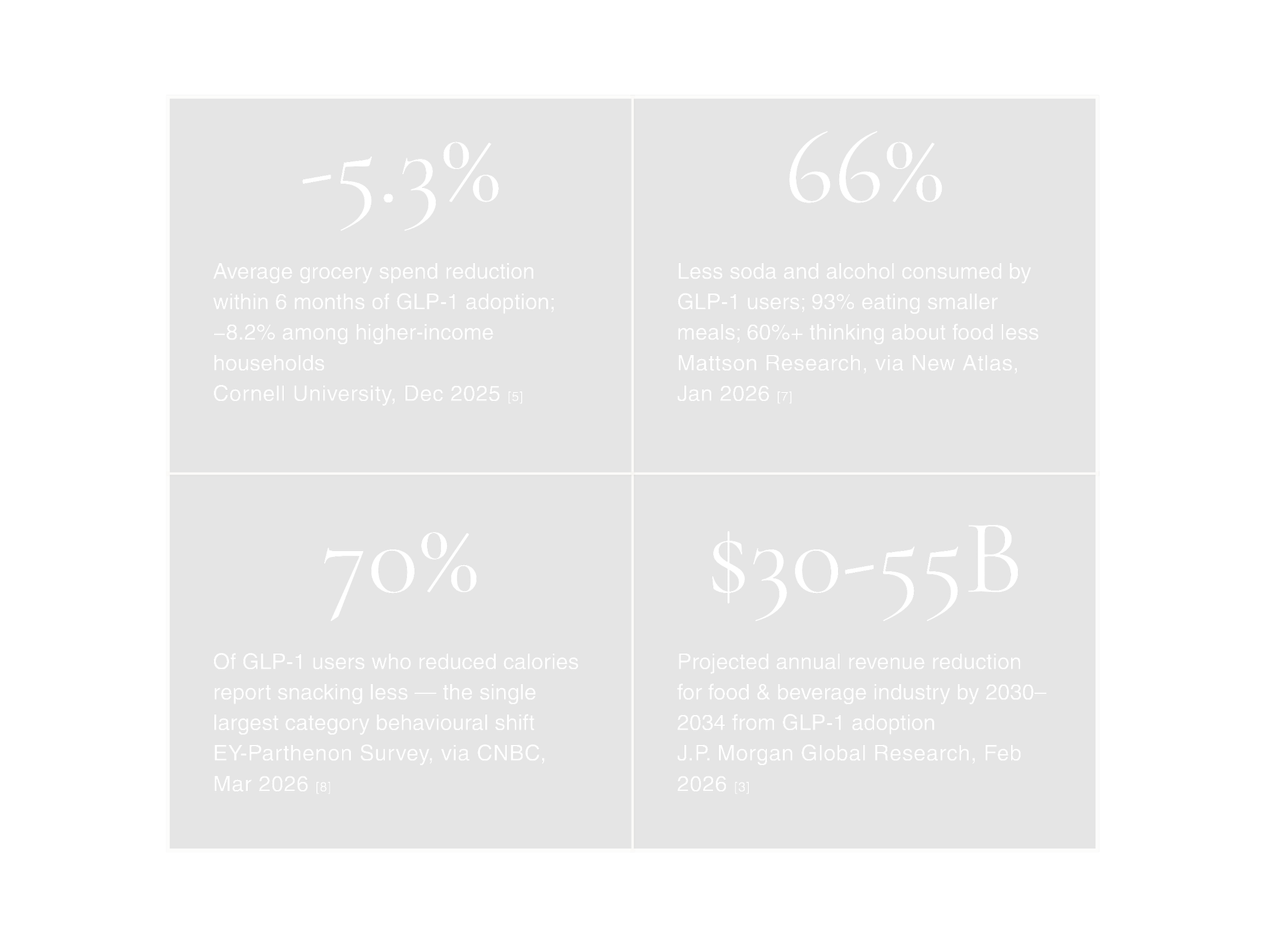
The key finding: households with at least one GLP-1 user cut their grocery spend by 5.3% within six months of adoption. Among higher-income households that figure rose to 8.2%.[5] Processed snacks, and sweet treats saw the largest cutbacks [6].
"The main pattern is a reduction in overall food purchases. Only a small number of categories show increases, and those increases are modest relative to the overall decline."
Sylvia Hristakeva, Cornell University, December 2025 [1]
In terms of appetite suppression, Mattson Research found GLP-1 users are drinking 66% less soda and alcohol, 93% are eating smaller meals, and over 60% report thinking about food less, what users commonly call the silencing of "food noise."[7] An EY-Parthenon survey found approximately 70% of GLP-1 users who had reduced calories said they were specifically snacking less, snacking having been one of the fastest-growing grocery segments for the previous decade.[8]
At the macro level, J.P. Morgan projects GLP-1 adoption will lead to an annual revenue reduction of $30–$55 billion for the food and beverage industry by 2030–2034, with consumers taking in 21% fewer calories and spending 31% less on groceries overall [3]. Morgan Stanley independently forecasts a 4% decline in soft drink, alcohol, and salty snack consumption over the next decade.[9]
One finding worth flagging specifically for hospitality and restaurant businesses: despite reducing retail grocery purchasing, Circana's data shows GLP-1 users tend to spend more at restaurants and food service than before starting the medication, not less.[4] The driver appears to be the convenience of single-portion options and the practical challenge of cooking separate meals in households where only one person is on the drug. This is a genuine and underserved opportunity for quality-led hospitality concepts.
Potential Outcome A - A shift towards ‘Less but Better’.
The Cornell data shows an overall reduction in purchasing, but the categories gaining (yogurt, fresh fruit, nutritional bars, protein-rich snacks [1] ) tell a clear directional story: These are not cheap products. They are products that justify their price through quality, or functional benefit. When appetite is no longer the dominant driver of consumption, consumers become more discerning. GLP-1 Users consistently report that because they are consuming less, each meal carries more psychological weight, the products that lead on quantity and volume lose competitive advantage while the carefully sourced, genuinely nourishing, and thoughtfully made products become more appealing.
01 Ingredient Provenance
When eating less, the origin and quality of what you eat matters more. Traceable sourcing, craft production, and origin stories justify premium pricing in a way that was impossible when volume was the primary value driver.
02 Nutrient Density
Smaller portions must work harder nutritionally. High-protein, micronutrient-dense formats are the fastest-growing food subcategory and GLP-1 users are the core demand driver. Brands positioning here now will own the shelf in three years.
03 Sensory Experience
Eating becomes an event rather than a reflex. Texture, aroma, flavour complexity, and ritual all command a premium when volume is removed from the value equation. This is where luxury food brands have always lived and the wider market is moving towards them.
The global luxury food market, valued at $195 billion in 2024, is forecast to grow at a CAGR of 16.5%, reaching $898 billion by 2034.[10] The broader gourmet food segment was valued at $542 billion in 2025 and is projected to reach $931 billion by 2034.[11] These growth rates are not coincidental to the GLP-1 trend they are the same cultural shift expressed in different datasets.
Mass brands are already reacting: Protein Works and Huel both have meal replacement drinks specific to those on GLP-1 diets, Nestle launched Vital Pursuit in 2024, a frozen food brand explicitly targeting GLP-1 users. Conagra began labelling products "GLP-1 Friendly." Chipotle launched grab-and-go protein cups. Olive Garden released a Lighter Portions menu.[8] These are tactical responses from volume brands under pressure. The premium positioning opportunity, purpose-built, brand-coherent, quality-led, remains largely unclaimed.
OUR PERSPECTIVE
The hospitality opportunity is real and currently underexploited by premium brands. GLP-1 users are not eating out less, they are eating out differently. Quality of experience is replacing quantity of food as the primary driver of spend. Brands that can narrate and deliver that shift will capture the growth.
The Ripple Into Every Category
The "less but better" logic does not stop at the kitchen. In our brand strategy work, we consistently observe that shifts in how consumers relate to one consumption category migrate across their broader spending behaviour over time. A consumer actively reconditioning their relationship with volume in food begins, often consciously, sometimes not, applying that same lens to fashion, homewares, beauty, and technology.
The second-hand luxury market, capsule wardrobe thinking, cost-per-wear calculation, the resurgence of quality furniture with durability and repair credentials, these trends have been building for several years. GLP-1 adoption is not creating them. It is reinforcing and accelerating an underlying value shift already in motion: away from disposability and replacement cycles, towards fewer, better, longer-lasting choices.
"Increased GLP-1 adoption may weigh on discretionary food categories while supporting shifts in consumer behaviour, including more spending on fitness and higher-quality dining experiences."
— Morgan Stanley Research, April 2026 [12]
An Alternative Interpretation - Impulsiveness with no consequences
For decades, the dominant consumer logic has been present-tense, satisfy the craving now, deal with the consequences later. Ultra-processed food, fast fashion, planned obsolescence: all expressions of present-bias, optimised for the frictionless moment of acquisition. Taking a weekly injection to manage weight is simply the latest extension of that same logic, removing the long term consequence of impulsive dietary choices entirely.
Before GLP-1 medication was accessible, when losing weight was perceived ‘hard’, people still made impulsive dietary choices, but they did so knowing there was a cost. Now, with an accessible way out, the mental calculation shifts from ‘if I eat this, it will take me ages to lose the weight but what the hell, I don’t care’ to ‘I can eat however I like, because I can always lose weight on GLP-’.. Increasing the impulsivity and poor dietary choices of the general population, people who have never taken the medication and subconsciously even those who never plan to.
In addition, despite reducing retail grocery spend, GLP-1 users actually outspend non-users in aggregate, and 50% of those who discontinue are likely to restart, pointing to a degree of ongoing reliance. What seems probable is a split dynamic: those actively on the medication experience a temporary reorientation toward quality over quantity, with improved impulse control. But for those who have come off it, or haven't started yet, the mere existence of an easy exit may accelerate impulsive behaviour rather than curb it.
At ALM, we are already working with clients to get ahead of this shift at the brand strategy level. The market is likely to bifurcate. A segment of consumers will move toward greater intentionality and preference for product quality over quantity. While the majority may become more impulsive, emboldened by the cultural permission that an easy corrective exists. The right brand position depends on which consumer you are building for, and where your brand currently sits.
If you already lead on quality: Continue to speak to those who look for quality over quantity. Reframe your brand story around the values becoming more mainstream and trendy again (intentionality, provenance, experience over volume).
If you are in the middle market: The middle ground, not cheap enough to compete on price, not distinct enough to compete on quality, is the most exposed position in this shift. The strategic question is which direction to move. In our experience advising brands through category disruption, the move toward quality is almost always the more defensible long-term choice. But it requires genuine product and brand investment, not just repositioning language.
If you are a volume-led brand: Slight reformulation towards nutrient density, format innovation towards smaller premium portions, and brand narrative work around quality and intentionality are all levers being pulled by category leaders right now. But the alternative interpretation is worth holding alongside this: if a portion of the mass market becomes more impulsive as consequence is decoupled from behaviour, volume brands that can capture that moment, with genuine sensory quality rather than empty indulgence, may find unexpected headroom.
The brands that will define the next decade of premium consumer culture are not the ones waiting to see how this plays out. They are the ones building their positioning now, while the shift is still early enough to own a distinct point of view within it.
If you would like help adapting your brand strategy, book a strategy session with us today.
SOURCES & REFERENCES
01
Ozempic Is Changing the Foods Americans Buy
Cornell University / Journal of Marketing Research — December 2025
Linked GLP-1 survey data with Numerator household purchase records across tens of thousands of US households. Found 5.3% grocery spend reduction within 6 months; largest declines in snack foods, chips, and bakery. Modest gains in yogurt, fresh fruit, nutrition bars, and meat snacks. GLP-1 household share rose from 11% (late 2023) to 16% (mid-2024).
02
Gallup National Health and Well-Being Index
Gallup — 2025
Found the number of Americans taking semaglutide or tirzepatide for weight loss more than doubled in 18 months, from 5.8% of respondents in February 2024 to 12.4% by late 2025. Also recorded a corresponding drop in the US obesity rate from 39.9% (three years prior) to 37% in 2025.
03
How Supply and Demand for Weight Loss Drugs Is Playing Out in 2026
J.P. Morgan Global Research — February 2026
Forecasts ~25 million Americans on GLP-1 treatment by 2030 (up from ~10 million in 2025, 6 million in 2024). Projects $30–55 billion annual food and beverage revenue reduction by 2030–2034, with consumers consuming 21% fewer calories and spending 31% less on groceries. Global incretin market forecast: $200 billion by 2030.
04
GLP-1 Medication Users to Represent 35% of US Food and Beverage Sales by 2030
Circana Research — November 2025
GLP-1 user households currently account for 23% of all US households and are projected to represent 35% of all food and beverage units sold by 2030. Despite reducing retail grocery purchasing, GLP-1 users outspend non-users overall. Users tend to spend more at restaurants. 50% of previous users are likely to restart medication, retaining health-conscious behaviours.
05
GLP-1 Users Cut Food Spending by 5.3%
Food Business News / Cornell University — December 2025
Household grocery spend fell 5.3% within 6 months of GLP-1 adoption on average, rising to 8.2% among higher-income households. Effect persists for at least 12 months among those who remain on the medication. After discontinuation, spending patterns largely return to pre-adoption levels.
06
GLP-1 Drugs Impact Food Spending and Producers — Category Detail
New Atlas / Cornell University — January 2026
Detailed breakdown of purchasing category shifts among GLP-1 users. Processed snack foods, chips, cookies, and bakery items saw the largest cutbacks. Only modest increases recorded in healthier categories. "The pattern is less about switching to 'better' foods and more about simply buying less food" — Prof. Jura Liaukonyte, Cornell.
07
GLP-1 Drugs Impact Food Spending — Mattson Consumer Research
Mattson Research, via New Atlas — January 2026
GLP-1 users report drinking 66% less soda and alcohol. 93% are eating smaller meals. More than 60% say they think about food less — the suppression of "food noise" being one of the most consistently self-reported effects across user groups and one of the most commercially significant behavioural changes for food and beverage brands.
08
GLP-1 Drugs Are Changing How Americans Eat. Food Companies Are Racing to Catch Up.
CNBC — March 2026
EY-Parthenon survey: ~70% of GLP-1 users who reduced calories report snacking less. Documents brand responses including Nestle's Vital Pursuit launch (2024), Conagra's "GLP-1 Friendly" labelling, Chipotle's protein cups, and Olive Garden's Lighter Portions menu. KFF poll: approximately 1 in 8 US adults currently on a GLP-1 drug.
09
How Ozempic Is Affecting Food Sales — Morgan Stanley Forecast
Morgan Stanley, via Tilley Distribution — September 2025
Morgan Stanley forecasts a 4% decline in soft drink, alcohol, and salty snack consumption over the next decade attributable to GLP-1 adoption. Also references Walmart's internal pharmacy and grocery data correlation, making Walmart one of the first major retailers to formally connect GLP-1 usage data with measurable food sales impact.
10
Luxury Food Market Size, Share | CAGR of 16.5%
Market.us Research — 2025
The global luxury food market is valued at $195 billion in 2024 and expected to reach $898 billion by 2034, at a CAGR of 16.5%. North America holds a 44.7% share valued at $87.1 billion. High-end restaurants account for 67.3% of the market by channel. FAO data cited: global specialty food consumption rose 22% between 2018 and 2023.
11
Gourmet Food Market Size, Share and Industry Report 2026–2034
Fortune Business Insights — 2026
Global gourmet food market valued at $542.43 billion in 2025, projected to grow to $931.15 billion by 2034 at a CAGR of 6.25%. Europe holds the largest regional share at 38.35%. Online and D2C is the fastest-growing distribution segment at a forecast CAGR of 7.08% through 2034, reflecting the subscription and direct-provenance purchasing trend.
12
GLP-1 Market Expected to More Than Double to $190B by 2035
Morgan Stanley Research — April 2026
Morgan Stanley forecasts the global GLP-1 market reaching $190 billion by 2035 (peak, more than double 2025 levels) with a bull case of $240 billion. Estimates GLP-1 adoption could reduce US calorie consumption by ~1.6% by 2035 — which at scale has significant food and beverage industry implications. Increased spending on fitness and higher-quality dining identified as key co-effects. Currently only ~6% of eligible US obesity patients are on GLP-1 therapy, indicating substantial runway ahead.